Two padded mailers can look almost identical on a shelf and end up in completely different places after your customer opens the box. One drops into the curbside bin and gets recycled; the other has to go in the trash because its layers can never be separated. The difference is not the printing or the color. It is the material mix underneath, and with packaging laws now tightening in a growing list of states, that mix is becoming a decision worth making on purpose rather than by default.
This is a plain-language guide to which padded mailers are actually recyclable, why the most common “eco-looking” option is often the worst of the bunch, and what the new wave of packaging regulation is starting to expect from the mailers you buy.
The material mix decides everything
Recycling systems sort by material, not by intention. A mailer made entirely of paper fiber can flow through the same stream as cardboard. A mailer made of plastic film can be recycled too, but only through a different channel. The problem arrives when a single mailer combines the two in a way no facility can pull apart. That is the whole story in one sentence: a mailer’s fate is set by whether it is all one material or a fusion of several, and a shopper cannot always tell which they are holding.
Plastic mailers are typically low-density polyethylene, resin code #4. That film is genuinely recyclable, but it cannot go in a curbside bin, because loose film wraps around the spinning screens at a materials recovery facility and jams the equipment. It has to be clean, dry, and taken to a store drop-off point alongside grocery bags. Paper mailers, by contrast, are accepted curbside in most programs. The trouble child is the mailer that tries to be both.
Where each mailer type actually ends up
There are four common constructions, and they sort into four very different pathways. An all-paper padded mailer, including the honeycomb-wrapped kraft style, is curbside recyclable and does not even need its layers separated, because there is no plastic padding to remove. A plain poly mailer and a poly bubble mailer are both LDPE film: recyclable, but only via store drop-off, and the bubble version should be punctured and flattened first.
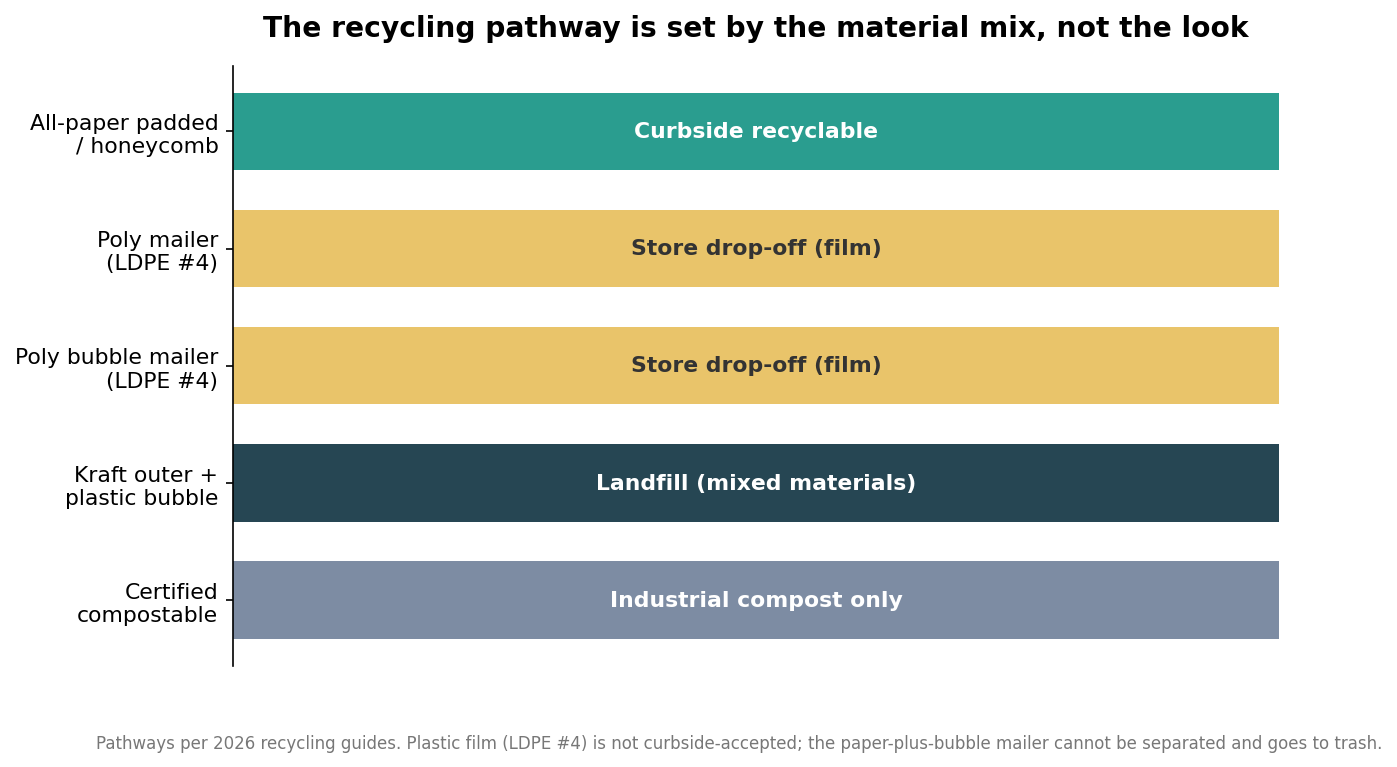
The kraft-look bubble mailer is the trap. It has a paper exterior that reads as recyclable and a plastic bubble lining fused to the inside, and because those two materials cannot be separated by hand or by machine, most guidance sends it straight to landfill. It is often the mailer a brand reaches for precisely because it looks sustainable, which makes it the most common well-intentioned mistake in the category. The fifth option, a certified compostable mailer, is its own special case: it belongs in industrial composting, not the recycling bin and not a backyard pile unless it is specifically certified for home composting.
Why “looks recyclable” is not the same as recyclable
The kraft-look mailer illustrates a broader point that matters for any brand thinking about its packaging story. Customers increasingly read the mailer as a signal, and a paper-faced mailer that ends up in the trash undercuts the very message it was meant to send. Worse, it can contaminate a batch if a well-meaning customer tosses it in the recycling, where the plastic lining becomes a problem for everything around it. Honesty scales better than appearance here. An all-paper mailer that a customer can genuinely recycle at the curb does more for a brand than a plastic-lined one that merely looks the part.
This is also where clear on-pack guidance earns its keep. A short line telling the customer exactly what to do, recycle at the curb, take to a store drop-off, or compost industrially, converts good material choices into good outcomes. The material sets the ceiling; the instruction helps the customer reach it.
What packaging laws are starting to expect
The regulatory backdrop is shifting from voluntary to mandatory. Seven states have now enacted extended producer responsibility laws for packaging, which shift the cost of collection and recycling onto the companies that put packaging on the market and, in several cases, charge lower fees for materials that are genuinely recyclable. Oregon’s program began charging producer fees in July 2025 and Colorado’s followed in early 2026, so as of now these obligations are live, not hypothetical. California, Maine, Maryland, Minnesota, and Washington are phasing in through the rest of the decade.
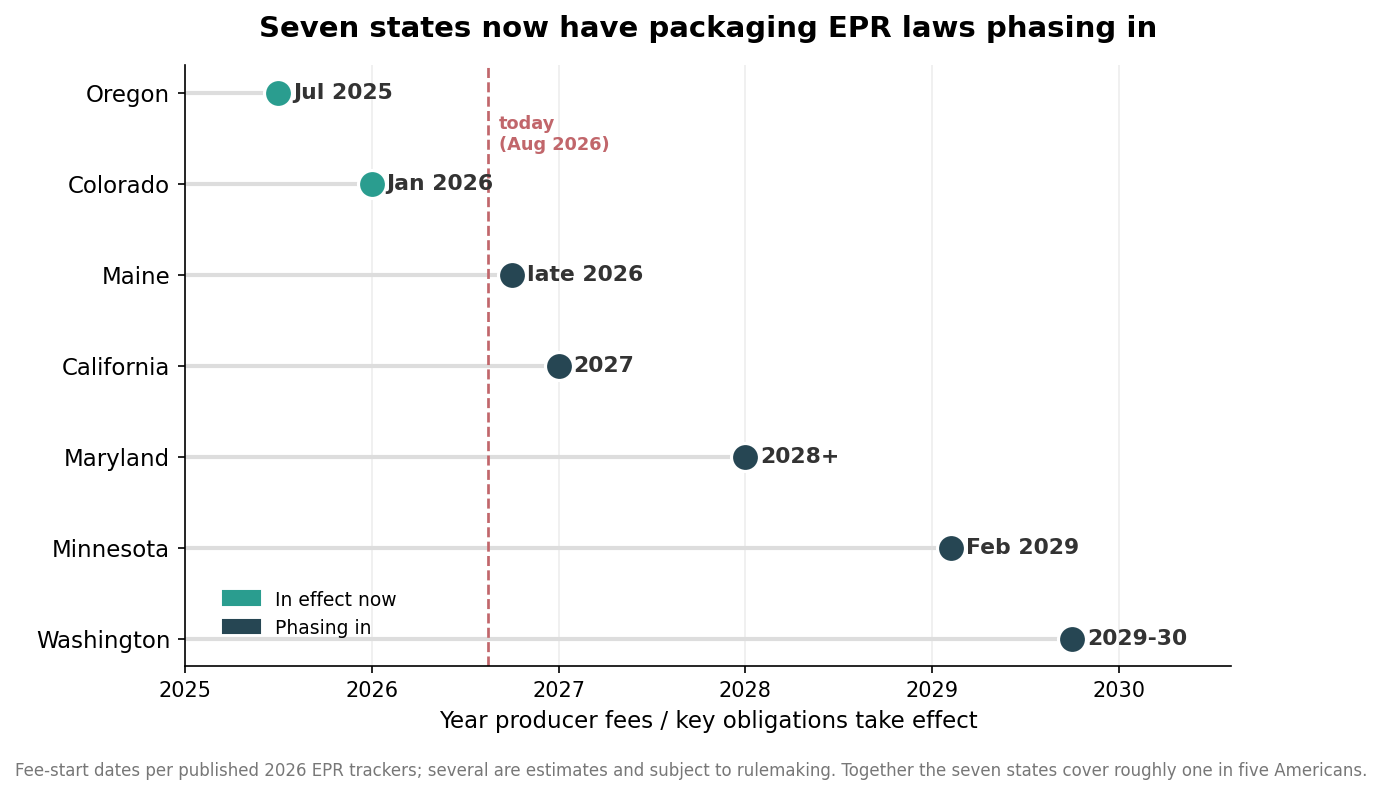
Together those seven states cover roughly one in five Americans, which means a brand shipping nationwide is already touching EPR jurisdictions whether it has noticed or not. The exact fees and rules are still being written, and the dates above are best read as a direction of travel rather than fixed deadlines, but the direction is unambiguous: mixed-material packaging that cannot be recycled will tend to cost more to put on the market, and clean single-material packaging will tend to cost less. Choosing an all-paper or a clean-film mailer today is partly a bet that the rules will keep rewarding that choice.
Specifying a mailer that protects the item and passes the bin test
None of this means paper always wins. A poly bubble mailer is lighter, water-resistant, and often cushions a bit better for its weight, which still matters for the right product. The real task is to match the construction to both the item and the disposal story you want to be able to tell. Decide the priority first: if a clean recycling pathway and regulatory headroom matter most, an all-paper padded or honeycomb mailer is the honest choice; if moisture resistance and minimum weight rule, a mono-material poly or poly bubble mailer that can go to store drop-off is defensible, as long as you say so on the pack.
What is hard to defend is the mixed paper-and-plastic mailer chosen for looks, because it fails the item on nothing and fails the bin on everything. Pick a single dominant material, size it so the product is snug without excess, print the disposal instruction the customer actually needs, and the mailer will protect what is inside while landing where it should when the box is empty. That is a specification that holds up to a customer, a sorting line, and a regulator alike.
Leave a Reply