The choice between a padded mailer and a small box is usually framed as a protection question, but for most e-commerce sellers it is really a shipping-cost question. A mailer and a box that hold the same item can be billed very differently by the carrier, and a rule change that took effect in mid-2026 widened that gap. Before deciding what a product ships in, it helps to understand exactly how the postage is calculated, because the packaging that looks cheaper on the shelf is not always the one that is cheaper to send.
The real variable is billable weight, not the envelope
Carriers do not simply weigh a parcel and charge for that. They charge for the greater of two numbers: the actual weight on the scale, and the dimensional weight, which converts the space a package occupies into a weight. For a compact, soft item the actual weight wins and you pay for what the scale reads. For a light item rattling around in an oversized box, the dimensional weight can win, and you end up paying to ship air. This single mechanic explains most of the cost difference between a mailer and a box, and it is why the same product can cost meaningfully more to send in a carton.
A padded mailer helps here in two structural ways. It is soft, so it compresses to the contents rather than holding a fixed rigid volume, and it is small, so it rarely reaches the size at which dimensional weight is even calculated. A box, by contrast, defends a fixed volume whether or not the product fills it, and once that volume crosses a threshold the carrier starts charging for the cube instead of the contents.
How USPS decides the charge, and what changed in July 2026
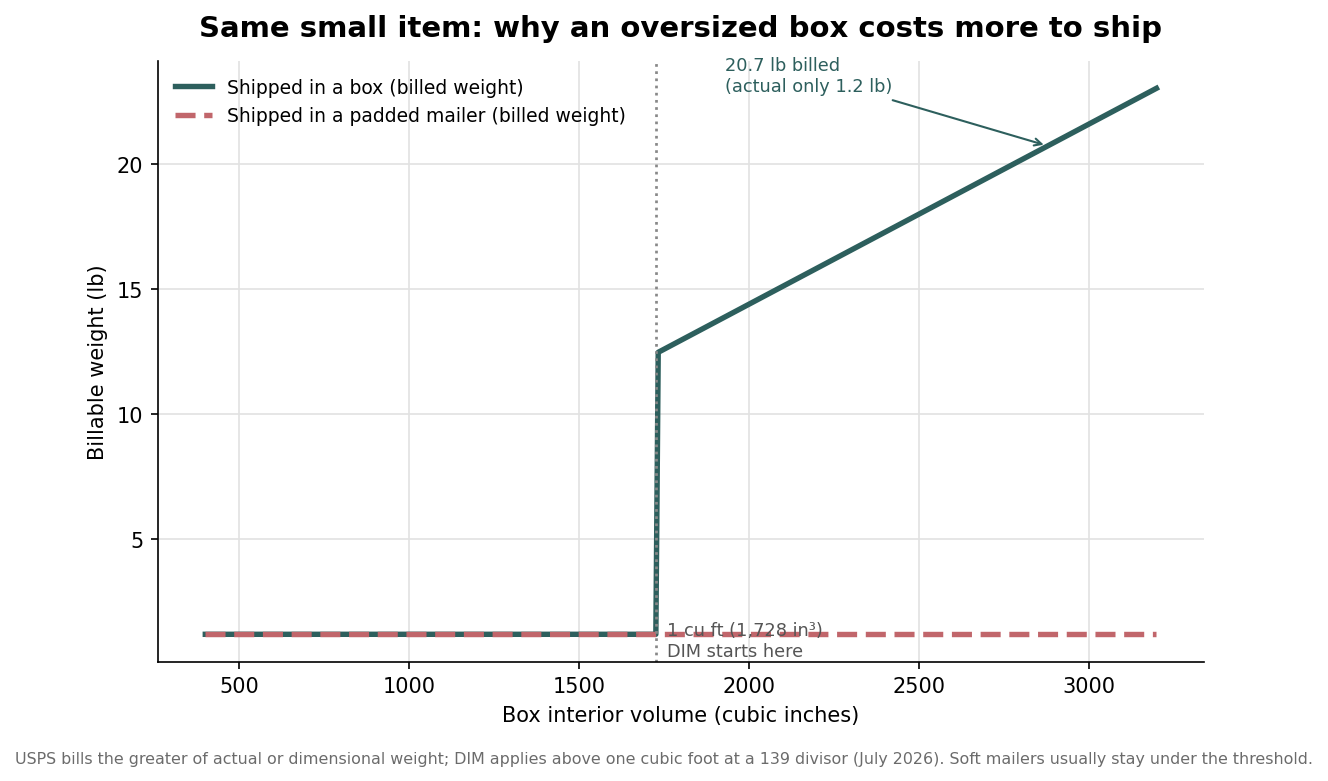
For USPS, dimensional weight applies to packages that exceed one cubic foot, which is 1,728 cubic inches. Below that size you are billed on actual weight regardless of shape, which is the zone most padded mailers live in comfortably. Above it, the carrier multiplies length by width by height and divides by a fixed number called the DIM divisor to get the dimensional weight in pounds, then bills whichever is larger.
The divisor is where the 2026 change bites. USPS lowered its DIM divisor from 166 to 139, bringing it in line with the divisors the private carriers already use. A smaller divisor produces a larger dimensional weight for the same box, so any parcel over a cubic foot now converts to more billable pounds than it did before. A 16 by 12 by 10 inch box encloses 1,920 cubic inches; under the old divisor that computed to roughly 11.6 pounds of dimensional weight, and under the new 139 divisor it computes to about 13.8 pounds, even if the actual contents weigh a few pounds. The chart below traces how billable weight climbs the moment a box passes the one-cubic-foot line, while the same goods in a mailer stay flat.
A second 2026 change is quieter but worth noting: USPS now expects accurate dimensions on commercial parcels for its main package services, and missing or wrong measurements can draw a per-parcel noncompliance fee reported at three dollars. The practical effect is that guessing at box dimensions to dodge dimensional weight is no longer a viable game; the measurement has to be right. A mailer that stays under the threshold sidesteps the whole exercise.
When a mailer wins, and when a box earns its space
A padded mailer is the cheaper carrier for flat, semi-flexible, or non-fragile-in-a-crush-sense goods: apparel, textiles, books, many health and beauty items, and small accessories. These products tolerate the mild compression a mailer allows, and they benefit from staying small enough that dimensional weight never enters the calculation. For a large share of direct-to-consumer catalogs, this describes the majority of orders.
A box earns its cost in specific cases. Rigid or brittle items that cannot take edge pressure, anything with corners that need to be held square, sets of multiple units that would make a mailer bulge into an awkward shape, and products where the unboxing experience is part of the brand all justify a carton. The honest tie-breaker is whether the box is sized to the product. A right-sized small box under one cubic foot is billed on actual weight just like a mailer; the expensive mistake is defaulting to a large box for a small item, which is exactly the scenario the new divisor punishes hardest.
The weight breaks that quietly decide the cost
Even when dimensional weight is not in play, packaging still shapes the bill through actual weight. Postage for lightweight parcels is sold in weight bands, and the empty weight of the packaging, its tare, eats into the band before the product is added. A mailer that weighs half an ounce leaves far more headroom under a given weight break than a box plus void fill that weighs several ounces. Across thousands of shipments, that difference decides how often orders tip into the next price tier.
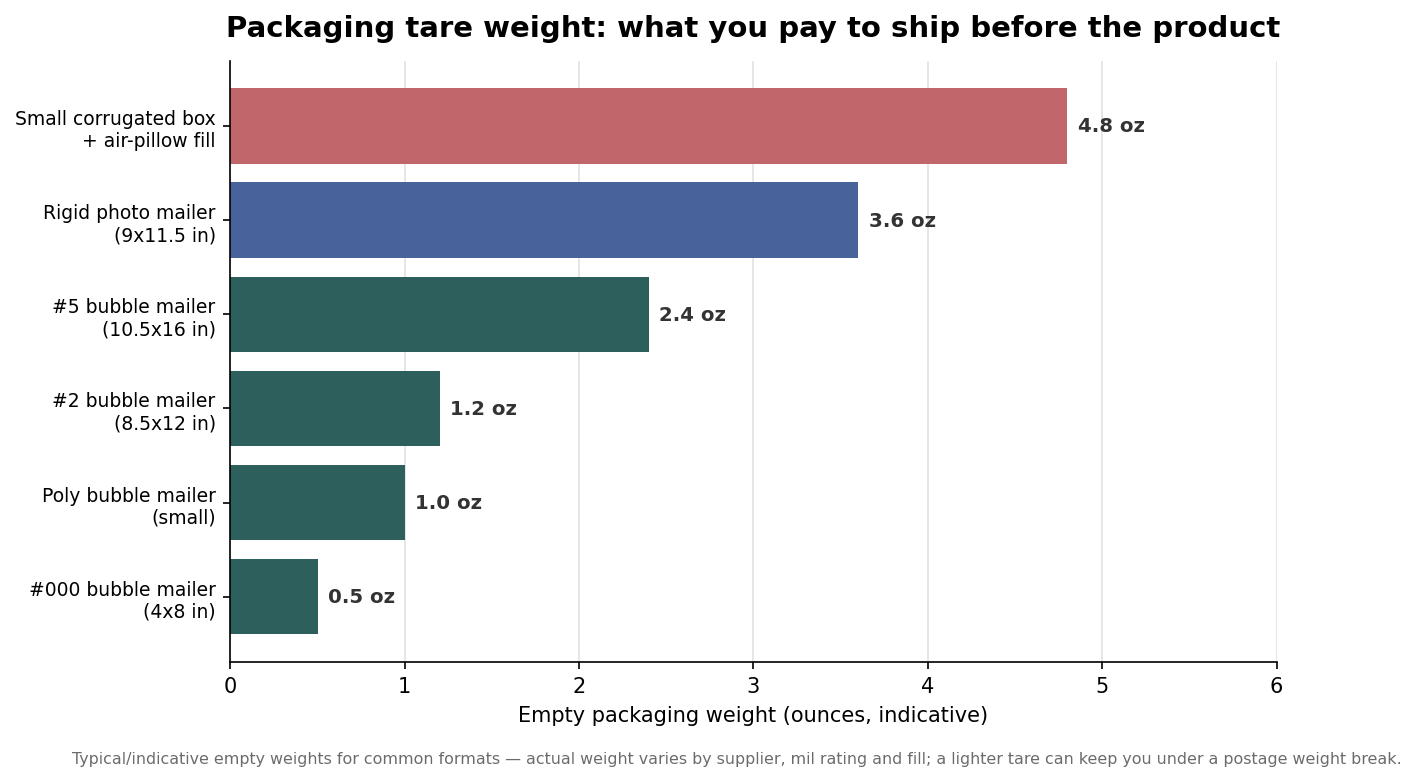
The figures above are indicative rather than exact, because tare weight varies with a mailer’s mil rating, its lining, and how much fill a box needs. The relationship, though, is stable: bubble and poly mailers typically weigh a fraction of what a comparable box plus cushioning weighs, and that margin is often the difference between clearing a weight break and paying for the next one. For products sitting just under a threshold, the packaging choice can matter more than any negotiation on rates.
Specifying a mailer that ships cheaply without underprotecting
The goal is the lightest, smallest format that still protects the product to the door, because that is also the cheapest to send. Match the mailer’s interior dimensions closely to the product so it stays flat and small, choose a bubble lining or mil rating suited to how much cushioning the item actually needs rather than over-specifying, and confirm the padded item still ships within the weight band you are targeting. For anything that genuinely cannot flex or take edge pressure, accept the box, but size it to the product so it stays under a cubic foot and off the dimensional-weight ledger.
Rates and rules move, so the specific divisor, thresholds, and fees here should be confirmed against current carrier notices before a large run. The underlying logic does not move: carriers bill for space as readily as for weight, and a padded mailer’s advantage is that it takes up almost none of the space that triggers the higher charge.
Leave a Reply