The single biggest driver of what a padded mailer costs to send is not its price on the shelf. It is how the United States Postal Service classifies the finished, filled piece the moment it hits the mail stream. The same product, packed two slightly different ways, can travel as an inexpensive flat or as a package that costs several times more. If you print and ship padded envelopes in any volume, understanding where those classification lines fall is worth more than almost any other packaging decision you make.
This is a rules explainer, not a rate sheet. USPS adjusts prices regularly, so treat every dollar figure here as indicative and confirm current rates before you lock a spec. The classification thresholds themselves, though, are stable, and they are what quietly decide your postage.
The three buckets USPS sorts every mailer into
Every mailpiece lands in one of three broad categories: a letter, a large envelope (which the Postal Service calls a “flat”), or a package. Each has its own price structure, and the jump between them is not gradual. A letter is the cheapest way to move something. A flat costs more but is still economical for lightweight, thin items. A package is the most expensive of the three, and once a piece is classified as one, it is priced by weight and dimension on a completely different scale.
The dimensions that separate these buckets are specific. A letter maxes out at 11.5 inches long, 6.125 inches high, and a quarter inch thick, with a weight ceiling of 3.5 ounces. It must be rectangular, flexible, and fall within an aspect ratio of roughly 1.3 to 2.5 (length divided by height). A large envelope or flat is allowed to be bigger and thicker: up to 15 inches long, 12 inches high, and three-quarters of an inch thick, carrying as much as 13 ounces. Anything that exceeds those flat limits, or that fails the physical tests described below, is a package.
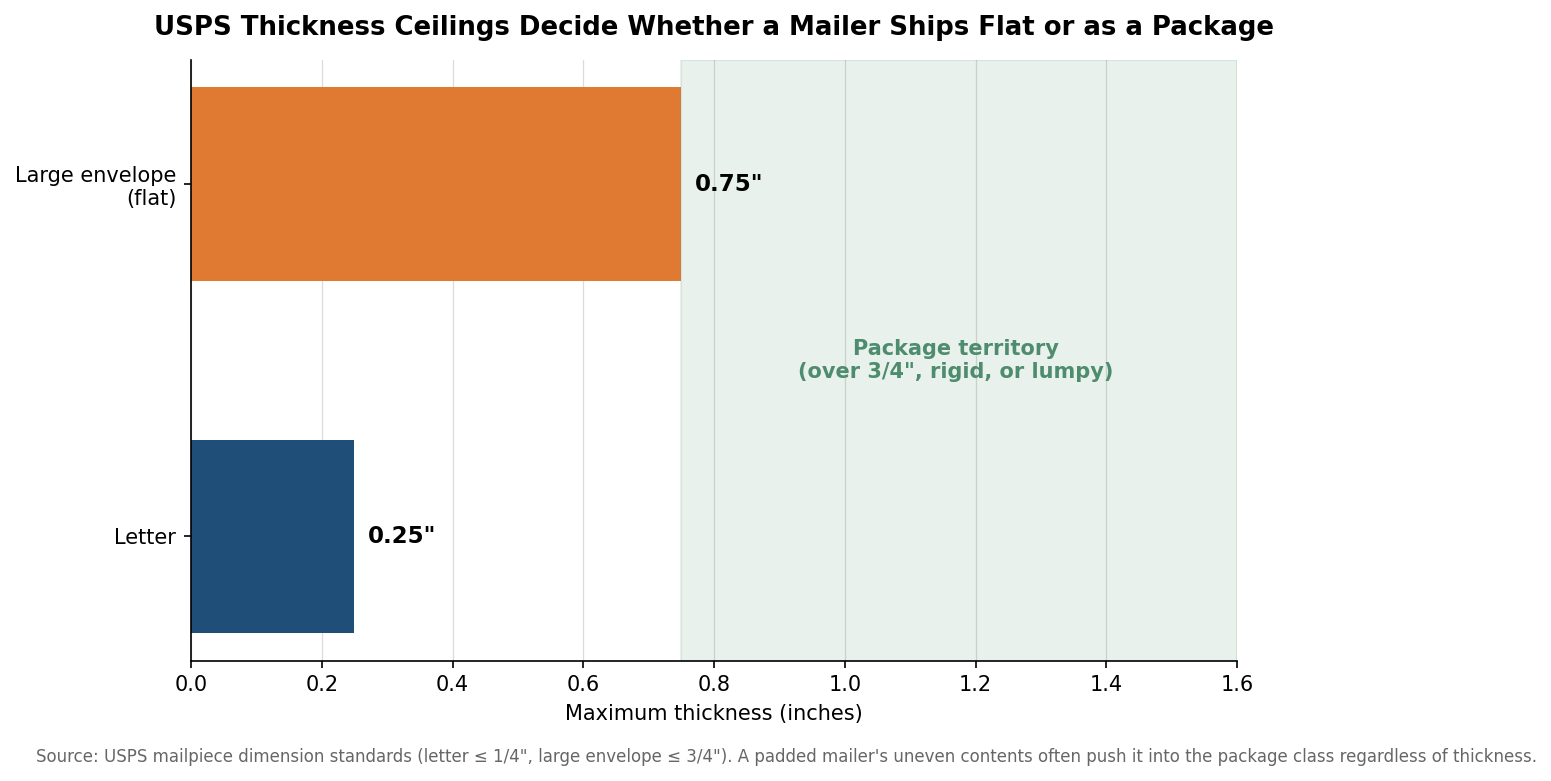
The thickness line that sends a padded mailer into “package”
The three-quarter-inch thickness ceiling is the threshold most padded-mailer shippers run into first. A flat has to stay under 0.75 inches at its thickest point. A slim document mailer with a sheet or two inside stays well under that. But the moment you slide in something with real depth, a small jar, a folded garment, a boxed accessory, the filled mailer swells past three-quarters of an inch and is priced as a package no matter how light it is.
Weight matters too, but it usually is not the binding constraint for padded mailers. The 13-ounce flat ceiling is generous relative to what most padded envelopes carry. In practice, thickness and shape push a mailer into the package bucket long before weight does. That is why a four-ounce order can still cost package postage: it is not heavy, it is simply too thick or too uneven to qualify as a flat.
Why padded mailers rarely qualify as flats even when they are thin
Here is the part that catches sellers off guard. Meeting the dimension limits is necessary but not sufficient. A flat also has to be uniformly thick and flexible. The Postal Service expects a large envelope to be bendable and consistent in thickness across the whole piece, the way a stack of paper in a paper envelope would be. A padded mailer with a rigid or lumpy item inside violates that expectation. It is thick in the middle and thin at the edges, and it does not bend cleanly. Postal equipment and clerks read that as a package.
This is also where the non-machinable concept comes in. When a piece is rigid, oddly shaped, or otherwise unable to run through automated sorting equipment, it can pick up a non-machinable surcharge on top of its base rate. For letters that surcharge is a modest per-piece add-on, in the range of forty-odd cents in recent rate cases, though the exact figure moves with each USPS pricing update. For padded mailers the more common outcome is not a surcharge but reclassification: the uneven, semi-rigid piece simply gets treated as a package from the start. The practical lesson is the same either way. Padding plus a three-dimensional object equals package pricing far more often than sellers expect.
What the classification actually does to your postage
The cost gap between these buckets is large enough to reshape a product’s margins. A one-ounce letter travels for well under a dollar. A one-ounce large envelope costs roughly a dollar and a half to start. A small package under the Postal Service’s Ground Advantage service, the tier that replaced the retired First-Class Package Service in mid-2023, starts several dollars higher and climbs from there by weight and size. In round numbers, moving a light item from the flat bucket to the package bucket can roughly triple its postage.
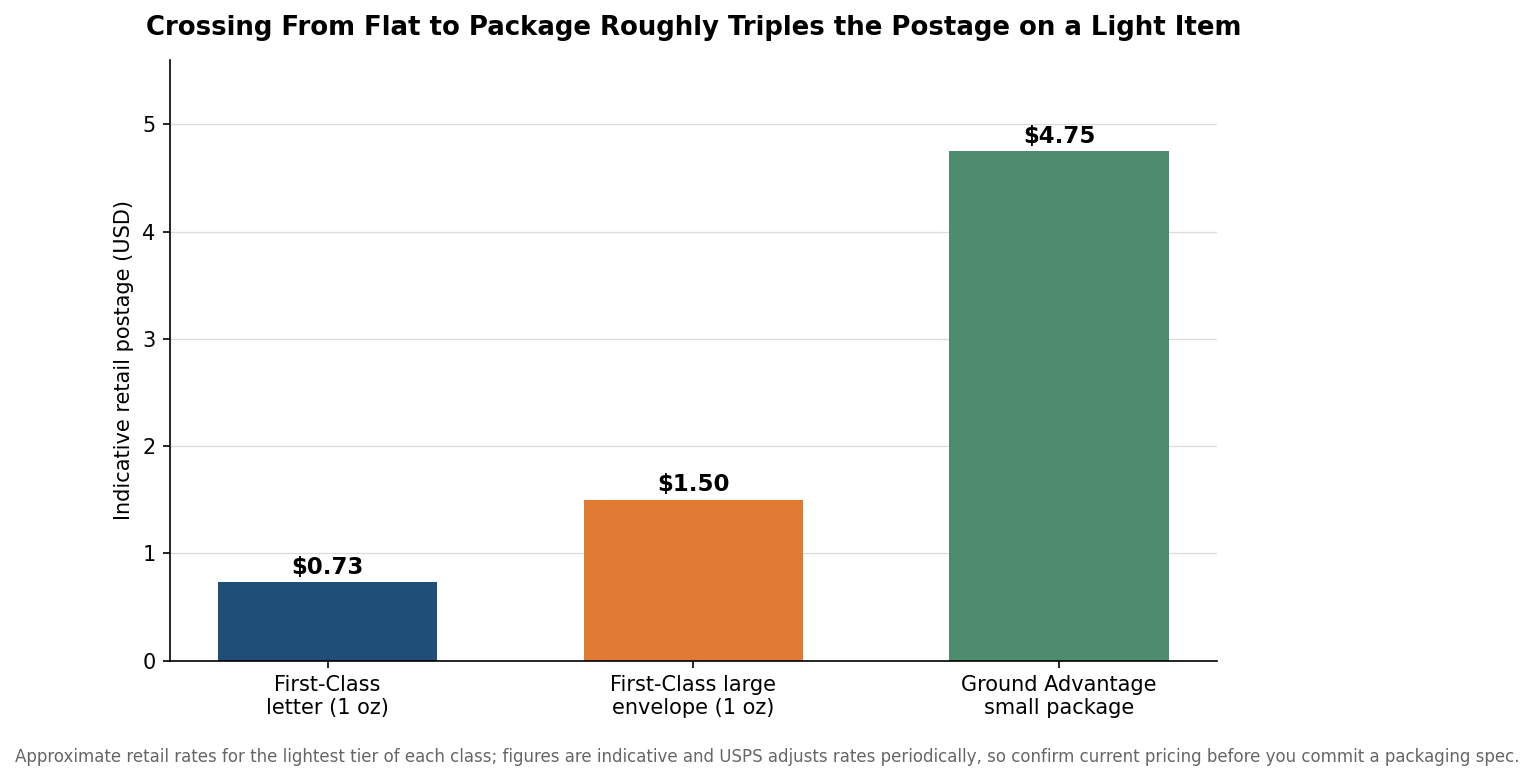
Multiply that gap across a few thousand shipments and the packaging decision stops being a rounding error. If your product genuinely needs cushioning and depth, package pricing is unavoidable and worth paying for, because a damaged arrival costs far more than the postage difference. The mistake is paying package rates by accident, on an item that could have shipped as a flat if the mailer had been specified a little differently.
How to specify a mailer that ships the way you planned
Start from the finished, filled thickness, not the empty mailer. Pack a representative product into a sample envelope and measure it at its thickest point. If it comes in comfortably under three-quarters of an inch, lies flat, and bends without resistance, you have a realistic shot at flat pricing, and you should choose a mailer sized so the contents stay flat rather than bunching. If the packed piece is over three-quarters of an inch, rigid, or lumpy, accept that it is a package and optimize for protection and dimensional efficiency instead, since package rates also respond to overall size.
For film-based poly bubble mailers, keep durability standards in mind as well. As a rule of thumb, mailer film should be at least 2 mils thick for contents up to about five pounds and 4 mils for loads approaching ten pounds, so the mailer survives handling rather than splitting in transit. That is a separate question from postal class, but a burst mailer turns a cheap shipment into an expensive claim, so it belongs in the same specification conversation.
Finally, weigh and measure before you commit to a design, not after your first invoice. The classification rules are public and consistent, which means the postage outcome is predictable if you test a real packed sample against the thresholds. Decide deliberately which bucket your product belongs in, size and pad the mailer to match that decision, and confirm the current rate for that class before you order a run. Do that, and the postage line on your shipping bill stops being a surprise and becomes something you designed on purpose.
Leave a Reply