Choosing a bubble mailer looks simple until you are standing over a product with a tape measure, wondering whether a #0 or a #2 will actually hold it without crushing the corners or wasting half the envelope. The numbered sizing system that runs from #000 up to #7 is an industry convention shared by most suppliers, but the numbers themselves tell you nothing until you know what each one measures and how much usable room sits inside. This guide walks through the standard chart, matches sizes to the items people ship most, and explains how sizing feeds directly into your shipping rate and your custom print order.
The standard size ladder, #000 to #7
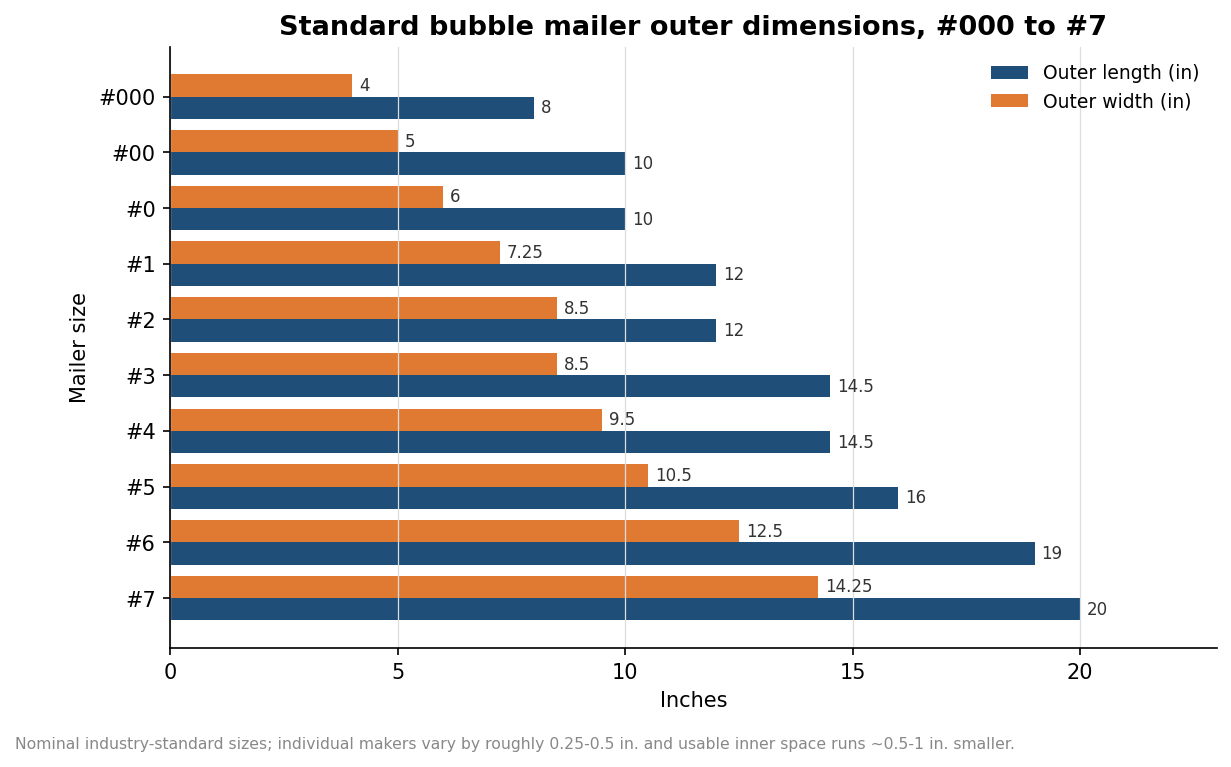
Most padded mailers on the market follow the same numbered ladder, and the dimensions are close enough between brands that you can shop by number with confidence. The smallest, #000, runs about 4 by 8 inches on the outside, and each step up adds width, length, or both. A #0 lands around 6 by 10 inches, a #2 around 8.5 by 12, a #5 around 10.5 by 16, and the largest common size, #7, reaches roughly 14.25 by 20 inches. The chart below lays out the full progression so you can see how width and length climb together rather than in lockstep.
Two sizes sharing a length is common: a #1 and a #2 are both about 12 inches long, but the #2 is wider, which matters when you are shipping something square rather than slim. Treat these figures as nominal. Individual manufacturers vary by roughly a quarter to a half inch, and a mailer labeled 6 by 10 from one supplier is not guaranteed to match another to the millimeter.
Match the size to what you are shipping
The fastest way to choose is to start from the product, not the envelope. A #000 suits genuinely small goods such as jewelry, coins, USB drives, cosmetics samples, or a single graded trading card in a top loader. Step up to a #00 or #0 for phone cases, sunglasses, a paperback, or CDs and DVDs, which is why the 6-by-10 size is a workhorse for media sellers. Around the middle of the ladder, a #1 or #2 handles trade paperbacks, folded soft goods like a single t-shirt, small electronics, and anything that fits a standard 8.5-by-11 sheet without forcing.
The larger numbers earn their keep with bulkier items. A #3 or #4 takes tablets, thicker books, or two folded garments, while a #5, #6, or #7 moves calendars, framed prints, larger apparel, and light housewares. When an item falls between two sizes, size up rather than down. A product wedged into a too-small mailer stresses the seams, defeats the padding by leaving no cushion around the contents, and often looks worse on the doorstep than a slightly roomier envelope with a little air in it.
Why usable space is smaller than the number on the label
The single most common sizing mistake is treating the printed dimensions as the space you get. Outer dimensions include the seal flap and the sealed side seams, and the bubble lining itself eats into the opening. As a rule of thumb, the usable interior runs about half an inch to a full inch smaller than the outer measurement in each direction, and the practical depth shrinks further once the padding compresses around a solid object. If your product measures 6 inches wide, a mailer with a 6-inch outer width will fight you at the opening; a 7.25-inch #1 gives the clearance to load it cleanly and still seal flat.
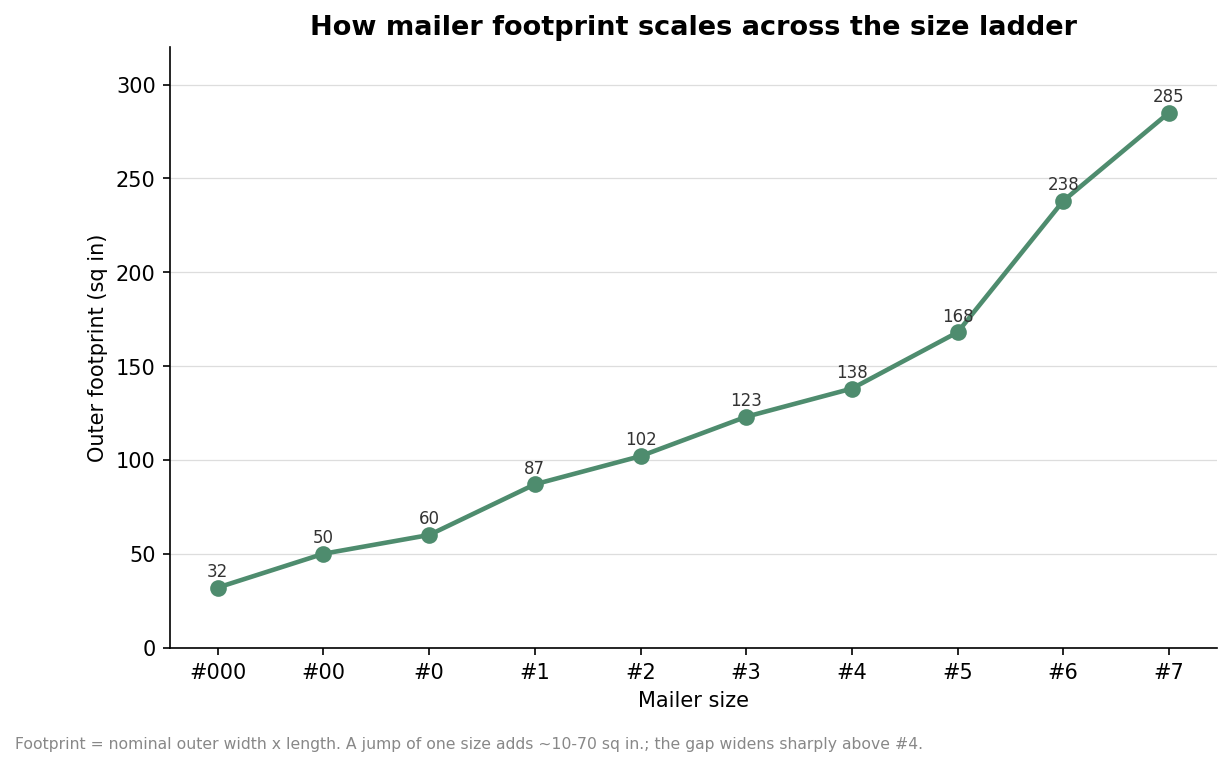
Footprint also does not grow evenly as you climb the ladder, which is worth understanding when you are deciding how many sizes to stock. The jump from one small size to the next adds only ten to twenty square inches, but above a #4 each step adds far more. The chart below shows how the outer footprint scales, and the steepening curve is a good argument for keeping a couple of mid-range sizes on hand rather than trying to force everything into one large mailer.
How size decides your shipping rate
Dimensions are not only about fit; they determine which postal rate you pay. To move at large-envelope or “flat” rates rather than parcel pricing, a mailer generally has to stay flexible, no more than about three-quarters of an inch thick, and under 13 ounces for First-Class service. A thin #0 holding a few photos can qualify as a flat and ship cheaply. Load that same envelope with a rigid boxed item, and it becomes a package the moment it exceeds the thickness limit or stops bending, which pushes it into parcel rates regardless of the number printed on it. Picking a size that keeps contents thin and even, rather than lumpy, is often the difference between two price tiers on the exact same shipment. Carrier rules change periodically, so confirm current thresholds with your carrier before committing a large run to one format.
Specifying size on a custom print order
When you order custom-printed mailers, size interacts with cost in ways that catch first-time buyers off guard. Fully custom work, meaning edge-to-edge printing and a made-to-order size, typically carries a minimum order around 5,000 units because the setup for offset or flexographic printing only pays off across a long run. Shorter digitally printed runs are available from some suppliers in the hundreds to low thousands, usually at a higher per-unit price. Lead times for printed mailers commonly land in the two-to-four-week range after art approval, though that figure moves with season, order size, and finishing choices, so treat it as a planning estimate rather than a promise.
Give your supplier the interior dimension your product needs plus your half-inch to one-inch clearance, and let them confirm the nearest stock tooling or a custom size. Ask specifically about dimensional tolerance, since a mailer that runs a quarter inch small on a tight product will generate returns and reprints that cost far more than getting the size right on the proof. Order a small sample or request exact interior measurements before locking a large quantity, because on a run of thousands, a half-inch error is not a rounding issue. It is the whole order.
Leave a Reply